Minoan Art Included Figures That Seem to Relate to an Ancient Cult of Sexual Power Based on the Bull

Two Minoan snake goddess figurines are a grouping of ancient sculptures that were excavated in 1903 in the Minoan palace at Knossos in the Greek island of Crete. The decades-long earthworks program led by the English archeologist Arthur Evans greatly expanded knowledge and awareness of the Statuary Age Minoan civilisation, but Evans has subsequently been criticised for overstatements and excessively speculative ideas, both in terms of his "restoration" of specific objects, including the almost famous of these figures, and the ideas about the Minoans he drew from the archeology. The figures are now on brandish at the Heraklion Archaeological Museum ("AMH").
The Knossos figurines, both significantly incomplete, date to near the stop of the neo-deluxe period of Minoan civilisation, around 1600 BCE.[1] It was Evans who called the larger of his pair of figurines a "Snake Goddess", the smaller a "Snake Priestess"; since then, information technology has been debated whether Evans was correct, or whether both figurines depict priestesses, or both depict the same deity or distinct deities.[2]

The combination of elaborate clothes that leave the breasts completely bare, and "snake-wrangling",[3] attracted considerable publicity, not to mention various fakes, and the smaller figure in particular remains a popular icon for Minoan fine art and faith, now also more often than not referred to as a "Snake Goddess". But archaeologists accept establish few comparable images, and a snake goddess plays little part in current thinking most the cloudy topic of Minoan faith.
Knossos figurines [edit]

The smaller figure before "restoration"
The two Knossos snake goddess figurines were found by Evans's excavators in i of a grouping of stone-lined and lidded cists Evans called the "Temple Repositories", since they contained a diverseness of objects that were presumably no longer required for use,[4] perchance after a fire.[5] The figurines are made of faience, a crushed quartz-paste material which later firing gives a true vitreous finish with bright colors and a lustrous sheen. This material symbolized the renewal of life in old Egypt, therefore it was used in the funeral cult and in the sanctuaries.
The larger of these figures has snakes crawling over her arms and up to her "tall cylindrical crown", at the top of which a serpent's head rears upward. The figure lacked the body below the waist, i arm, and function of the crown. She has prominent blank breasts, with what seems to be ane or more than snakes winding circular them. Because of the missing pieces, information technology is not clear if it is one or more snakes around her artillery. Her wearing apparel includes a thick belt with a "sacred knot".[half dozen]
The smaller figure, every bit restored, holds two snakes in her raised easily, and the figure on her caput-dress is a cat or panther. However, equally excavated, she lacked a caput and the proper left arm was missing beneath the elbow. The caput was recreated past Evans and one of his restorers. The crown was an incomplete fragment in the aforementioned pit, and the cat/panther was another separate slice, which Evans only decided belonged to the figure some time later, partly because there seemed to be matching fittings on the crown and true cat. Contempo scholars seem somewhat more ready to accept that the hat and cat belong together than that either or both belong to the residual of the figure.[vii]
A third figure, intermediate in size, is cleaved off at the waist, but the lower role is comparable. The cist as well contained another arm that might accept held a ophidian.
Other Minoan figures [edit]
Some other figurine now in Berlin, made of bronze, has on her head what may be 3 snakes, or just tresses of pilus. She seems to exist a priestess or worshipper rather than a deity, every bit she is stooped slightly forward, and making the Minoan worship gesture of a facepalm with one manus and the other brought up to the breast or, in this case, the throat. The i breast visible has a prominent nipple, so is presumably intended to exist blank. This is probably Tardily Minoan I, rather afterwards than the Knossos figures.[viii] [nine]
Afterward still are some terracotta votive offerings, probably representing the goddess rather than humans, in at least one case "ophidian-wrangling" and with snakes ascent from the diadem or headress. This blazon of effigy often has attributes rise from the headress, typified by the Poppy goddess (AMH).
Fakes [edit]
The tremendous bear on of the Knossos figures, once published by Evans and in a book by the Italian doctor Angelo Mosso, chop-chop led to ingenious fakes. A effigy in the Boston Museum of Fine Arts with an ivory body and gold snakes twined around the artillery is at present more often than not regarded as a fake. It was bought by the museum in 1914.[10] [9] [11]
Another figure, in the Walters Art Museum in Baltimore, is a small steatite blank-breasted female figurine with a serpent engraved around her headdress, and holes pierced through her clenched fists, presumably to propose these held snakes. This is also at present regarded equally a fake. It was bought by Henry Walters from a dealer in Paris in 1929, and left to the museum in 1931.[12]
-

The Boston ivory and gold figure, probably a fake, pre-1914. Gold snakes coil round the arms.[13]
-
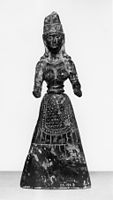
Baltimore rock figure, probably a faux, pre-1929. A snake winds round the headdress and the easily are pierced as if to concur snakes.
Interpretations [edit]

Evans' reconstruction of the "Snake Goddess Shrine": Objects from the Temple Repositories at Knossos, including the ii figures, soon after discovery in 1903.[14]
Emily Bonney regards the figures equally reflective of Syrian religion which had a brief impact on Crete, when "the elites at Knossos emulated Syrian iconography as an assertion of their admission to exotic knowledge and control of trade."[15]
The figurines are probably (according to Burkert) related to the Paleolithic traditions regarding women and domesticity.[16] The figurines have also been interpreted equally showing a mistress of animals-type goddess and as a precursor to Athena Parthenos, who is also associated with snakes.[2]

Detail of the larger Knossos figure; the parts below this are reconstructed.
The serpent is often symbolically associated with the renewal of life because it sheds its skin periodically. A similar belief existed in the ancient Mesopotamians and Semites, and appears also in Hindu mythology.[17] The Pelasgian myth of creation refers to snakes every bit the reborn expressionless.[18] However, Martin P. Nilsson noticed that in the Minoan religion the snake was the protector of the business firm,[16] as it later on appears also in Greek religion.[nineteen] Inside the Greek Dionysiac cult it signified wisdom and was the symbol of fertility.[17]
Barry Powell suggested that the "snake goddess" reduced in legend into a folklore heroine was Ariadne (whose name might mean "utterly pure" or "the very holy 1"), who is often depicted surrounded past Maenads and satyrs.[xx] Hans Georg Wunderlich related the ophidian goddess with the Phoenician Astarte (virgin daughter). She was the goddess of fertility and sexuality and her worship was connected with an orgiastic cult. Her temples were decorated with serpentine motifs. In a related Greek myth Europa, who is sometimes identified with Astarte in ancient sources, was a Phoenician princess whom Zeus abducted and carried to Crete.[21] [22] Evans tentatively linked the snake goddess with the Egyptian serpent goddess Wadjet but did not pursue this connectedness. Statuettes similar to the "snake goddess" blazon identified as "priest of Wadjet" and "magician" were found in Egypt.[23]
While the statuette'southward truthful function is somewhat unclear, her exposed and amplified breasts suggest that she is probably some sort of fertility figure. The figurines may illustrate the manner of dress of Minoan women, withal, it is also possible that bared breasts represented a sign of mourning. Homer gives a literary description of this kind of mourning,[24] and this was also observed by Herodotus amid Egyptian women.[21]
The snake goddess's Minoan name may be related with A-sa-sa-ra, a possible interpretation of inscriptions found in Linear A texts.[25] Although Linear A is not yet deciphered, Palmer[ clarification needed ] relates tentatively the inscription a-sa-sa-ra-me which seems to accept accompanied goddesses, with the Hittite išhaššara, which means "mistress".[26] : 256, 263
Sacral knot [edit]
Both goddesses have a knot with a projecting looped string between their breasts. Evans noticed that these are coordinating to the sacral knot, his name for a knot with a loop of fabric in a higher place and sometimes fringed ends hanging down below. Numerous such symbols in ivory, faience, painted in frescoes or engraved in seals sometimes combined with the symbol of the double-edged axe or labrys which was the most of import Minoan religious symbol.[26] : 161, 163 Such symbols were found in Minoan and Mycenaean sites. It is believed that the sacral knot was the symbol of holiness on human figures or cult-objects.[26] : 163 ff Its combination with the double-axe can be compared with the Egyptian ankh (eternal life), or with the tyet (welfare/life) a symbol of Isis (the knot of Isis).[27]
Art [edit]
The 1979 feminist artwork The Dinner Party by Judy Chicago features a place setting for a "Snake Goddess".[28]
Gallery [edit]
-

Minoan terracotta votive figure holding a ophidian or snakes, Kania, Gortyna, 1300-1200 BC, AMH
-

Bronze Minoan figure in Berlin, LM I, probably a worshiper, with either snakes or tresses of hair.[29]
-

Pot, probably a stand for rhytons, with snake, Knossos, 1700-1600 BC, AMH
-
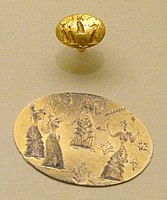
Gold ring & blow-up. 4 women with similar wearing apparel. The wavy line virtually the woman at far right has been called a snake.
-

Largely reconstructed relief fresco of a (?) goddess from Psira; one of the few figures with comparable bodices
See also [edit]
- Ishtar
- Gorgon (female monsters with sharp fangs and hair of living, venomous snakes in Greek mythology)
- Chief of Animals
- Matriarchal religion
- Wadjet
- Snake worship (in Hindu mythology)
Notes [edit]
- ^ German language; this is the boundary between Middle Minoan and Tardily Minoan
- ^ a b Ogden, Daniel (2013). Drakon: Dragon Myth and Serpent Cult in the Greek and Roman Worlds. Oxford University Press. pp. 7–9. ISBN9780199557325 – via Google Books.
- ^ German's term
- ^ Witcombe: two; German language
- ^ Hood, 133
- ^ Witcombe: 4; Hood, 133
- ^ Witcombe: 2; Hood, 133; High german
- ^ Hood, 112
- ^ a b "A statuette of the Minoan Ophidian Goddess. Souvenir of Mrs. W. Scott Fitz". Museum of Fine Arts Bulletin. 12 (73): 51–55. Dec 1914. JSTOR 4423650.
- ^ Boston: "She has long been admired past many experts, but some accept questioned her authenticity. Her face has been seen equally "too modern-looking," and her hips too narrow for a Minoan adult female. Scientific testing has proven inconclusive... most 1600–1500 B.C. or early 20th century". In 2021 it was not on display.
- ^ In 2002, one author still regarded it as "probably genuine" - Castleden, Rodney, Minoans: Life in Bronze Historic period Crete, p. 5, 2002, Taylor & Francis, ISBN 9781134880645, google books
- ^ "Serpent goddess", Walters, "The joining method, style, and material make the authenticity of this piece doubtful... 16th century BCE or early on 20th century".
- ^ Boston
- ^ Witcombe: iii
- ^ Bonney, Emily M. (2011). "Disarming the Snake Goddess: a Afterthought of the faience figurines from the temple repositories at Knossos". Journal of Mediterranean Archaeology. 24 (2): 171–190. doi:10.1558/jmea.v24i2.171.
- ^ a b Burkert, Walter (1985). Greek Organized religion . Harvard University Press. pp. 23, 30. ISBN0-674-36281-0.
- ^ a b "snake worship". Columbia. The free Dictionary.
- ^ Graves, Robert (2012). "Affiliate 1: The Pelasgian Cosmos Myth". The Greek Myths (Penguin Classics Deluxe ed.). Penguin. ISBN9780143106715.
- ^ Nilsson, Martin (1967). Die Geschichte der griechischen Organized religion [The History of Greek Organized religion] (in German). Vol. 1. Munich, DE: C.H. Beck Verlag.
Zeus Kresios in the guise of a snake is regarded the "protector of storehouses". A snake is the "skilful daemon" at the temple of Athena on Acropolis, etc.
[ page needed ] - ^ Powell, Barry; Howe, Herbert Grand. (1998). Classical Myth . Upper Saddle River, New Jersey: Prentice Hall Inc. p. 368. ISBN9780137167142.
with new translations of ancient texts by Herbert M. Howe
- ^ a b Wunderlich, H.Grand. (1994) [1975]. The Cloak-and-dagger of Crete. Efstathiadis group S.A. pp. 260, 276. ISBN960-226-261-3. (Outset British edition, published 1975 by Souvenir Press Ltd., London.)
- ^ Lucian of Samosata (200). De Dea Syria [On the Syrian Goddess]. 4.
- ^ Witcombe: eight
- ^ The Iliad, transl. by R. Lattimore. (1970) University of Chicago Press,Phoenix Volume p.437 (Book XXII 77-81)
- ^ Haarmann, Harald (2011). Das Rätsel der Donauzivilisation. Die Entdeckung der ältesten Hochkultur Europas (in German language). Munich, DE: Verlag C.H. Beck. p. 241. ISBN978-3-406-62210-6.
- ^ a b c Schachermeyer, F. (1964). Dice Minoische Kultur des alten Kreta [The Minoan Civilisation of Ancient Crete] (in German). Stuttgart: Kohlhammer Verlag.
- ^ Witcombe: 9
- ^ "Place Settings". artist Judy Chicago. Brooklyn Museum. Retrieved 6 Baronial 2015.
{{cite web}}: CS1 maint: others (link) - ^ Hood, 112
References [edit]
- "Boston": "Statuette of a snake goddess", Boston MFA page - "nearly 1600–1500 B.C. or early 20th century"
- German, Senta, "Snake Goddess", Khan University
- Hood, Sinclair, The Arts in Prehistoric Greece, 1978, Penguin (Penguin/Yale History of Art), ISBN 0140561420
- Witcombe, Christopher Fifty.C.E. "Minoan Snake Goddess". Retrieved 1 July 2006.
essay originally in Images of Women in Aboriginal Art
Further reading [edit]
- Lapatin, Kenneth, Mysteries of the Snake Goddess: Fine art, Desire, and the Forging of History, 2002, Houghton Mifflin ISBN 0618144757
External links [edit]
oppenheimerscaughbod.blogspot.com
Source: https://en.wikipedia.org/wiki/Minoan_snake_goddess_figurines
0 Response to "Minoan Art Included Figures That Seem to Relate to an Ancient Cult of Sexual Power Based on the Bull"
Post a Comment